Bounded AI
Intelligence without accountability creates instability. AI systems must remain subject to human governance, transparency, and oversight.
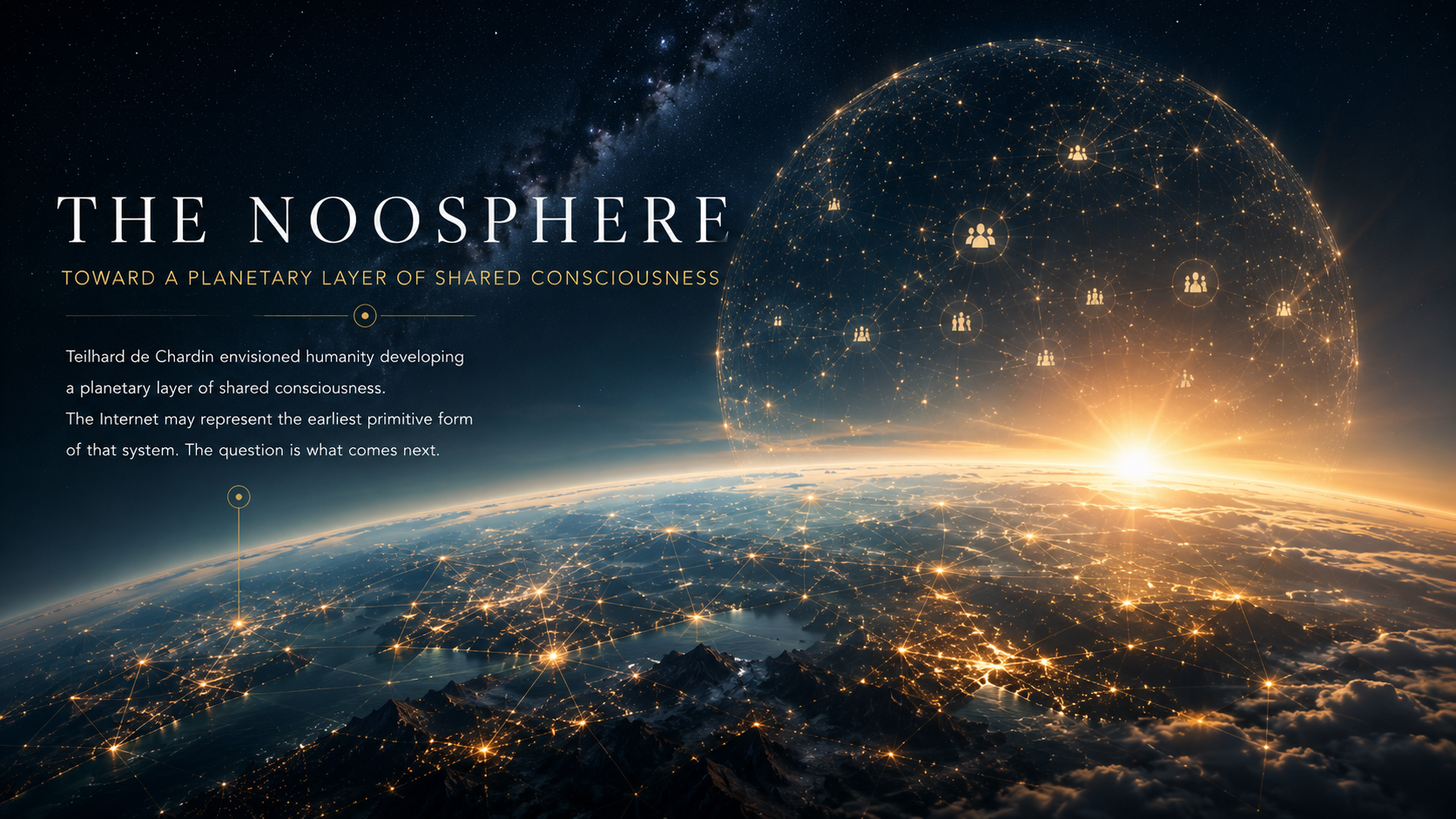
Teilhard de Chardin envisioned humanity developing a planetary layer of shared consciousness.
The Internet may represent the earliest primitive form of that system.
The question is what comes next.
Hypothesis
Humanity is becoming increasingly interconnected through systems of communication, memory, intelligence, and coordination.
Every conversation.
Every collaboration.
Every network.
Every intelligent system.
Contributes to an emerging layer of collective cognition.
Teilhard de Chardin called this possibility the Noosphere.
Today, advances in AI, digital communication, and global connectivity make this idea more relevant than ever.
Relevance
The challenge facing humanity is no longer merely information exchange.
It is collective sensemaking.
As intelligent systems become increasingly integrated into communication, governance, culture, and decision making, humanity requires new ways to coordinate knowledge, context, memory, and meaning.
The Noosphere offers a framework for understanding this transition.
Framework
Intelligence without accountability creates instability. AI systems must remain subject to human governance, transparency, and oversight.
Civilizations require memory. Digital culture requires durable reference points capable of surviving platforms and generations.
Meaning depends on context. Future systems may require shared semantic infrastructure capable of connecting knowledge across communities and domains.
Context should not belong exclusively to platforms. Communities must be able to contribute, govern, and share contextual understanding directly within digital environments.
Publications
Connection
The Meta-Layer explores infrastructure.
The Noosphere explores emergence.
The Meta-Layer asks:
What systems do we build?
The Noosphere asks:
What forms of collective intelligence become possible when those systems exist?
Next steps