
The Internet Needs a Civic Layer
The web gave humanity unprecedented access to information.
The next challenge is trust, context, memory, and coordination.
As AI increasingly mediates human experience, the Internet requires new civic infrastructure capable of supporting agency, accountability, and collective intelligence.
Context
Why Now
The Internet was built for pages.
Not for synthetic media.
Not for AI agents.
Not for contextual trust.
Not for collective governance.
For decades this architecture worked remarkably well.
Today a new challenge is emerging.
Artificial intelligence can now generate content, conversations, identities, images, code, and entire information environments at unprecedented scale.
The problem is no longer access to information.
The problem is making sense of information together.
Trust, context, provenance, memory, and coordination are becoming first-order challenges for digital society.
The next evolution of the Internet may depend on infrastructure designed specifically to support them.
Definition
What Is The Meta-Layer?
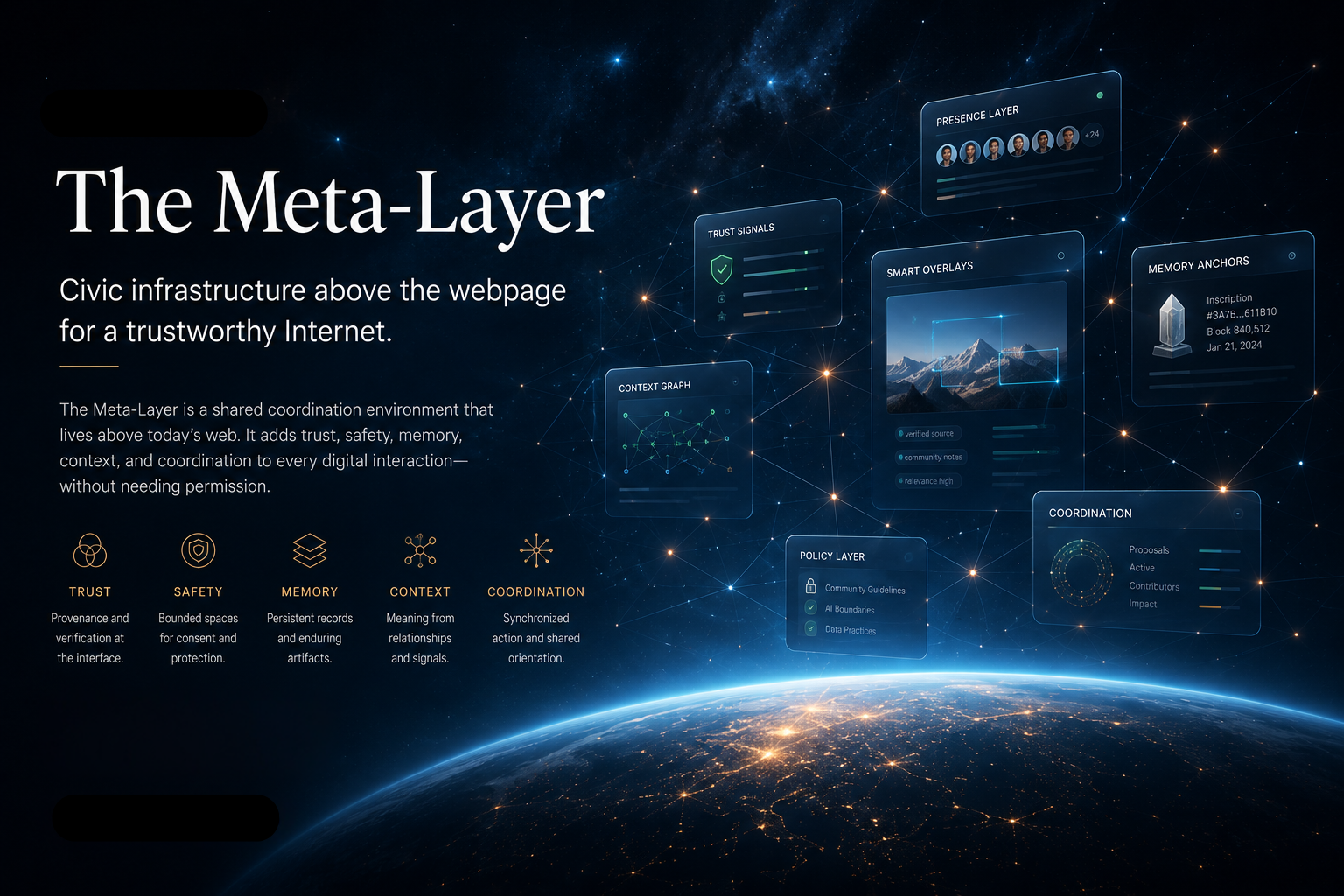
The Meta-Layer is an emerging civic layer above the webpage.
Rather than replacing the web, it introduces contextual infrastructure directly into digital environments.
Examples include:
- browser overlays
- contextual trust signals
- shared semantic systems
- community governance layers
- AI accountability mechanisms
- collective intelligence tools
These systems help people understand not only what they are seeing, but how it relates to broader networks of meaning, trust, participation, and responsibility.
The goal is not a new platform.
The goal is a better Internet.
Design principles
The Desirable Properties
The Meta-Layer Initiative has proposed a set of Desirable Properties intended to guide the development of trustworthy digital environments.
These properties explore how future Internet infrastructure can support:
- agency
- consent
- contextual integrity
- transparency
- accountability
- safety
- participation
- collective intelligence
The Desirable Properties are not technical specifications.
They are design principles for a more human-centered digital future.
Infrastructure
Browser Overlays
Most Internet innovation has focused on the page.
The Meta-Layer explores what becomes possible above the page.
Browser overlays can introduce:
- contextual explanations
- trust indicators
- community annotations
- governance tools
- collaborative intelligence systems
- AI accountability mechanisms
Without requiring people to leave the websites they already use.
In this model, the browser becomes more than a viewing tool.
It becomes civic infrastructure.
Stakes
Why It Matters
The future of the Internet is not merely technical.
It is civilizational.
The systems we build today will shape how humanity shares trust, memory, meaning, and collective intelligence for generations.
The Meta-Layer explores how that future might remain open, participatory, and aligned with human flourishing.
Next steps